Tag Archives: Teachers’ salaries

More pay for teachers, employees as TSC pays April salaries; Tax relief factored in

The Teachers Service Commission, TSC, has finally paid April salaries for teachers. The salaries, that usually hit teachers’ accounts from 22nd of every month, were delayed this month as the Commission waited to configure income tax in line with the new regulations.

The teachers, just like other employees in Kenya, have something to smile about as there is a marginal increase in their salaries after President Uhuru Kenyatta signed into law the Tax Laws (Amendment) Bill, 2020. The coming of this bill is part of measures instituted by the government to cushion the public against effects of the Covid-19 pandemic. Read details here; Employees to get increased salaries as President Kenyatta Assents To The Tax Laws (Amendment) Bill, 2020

In the new tax regime, employees earning less than Sh28,000 per month have been awarded a 100 per cent Pay As You Earn (Paye) tax relief. While those earning above the Sh28,000 have received a Paye tax reduction of between 30 and 25 per cent.
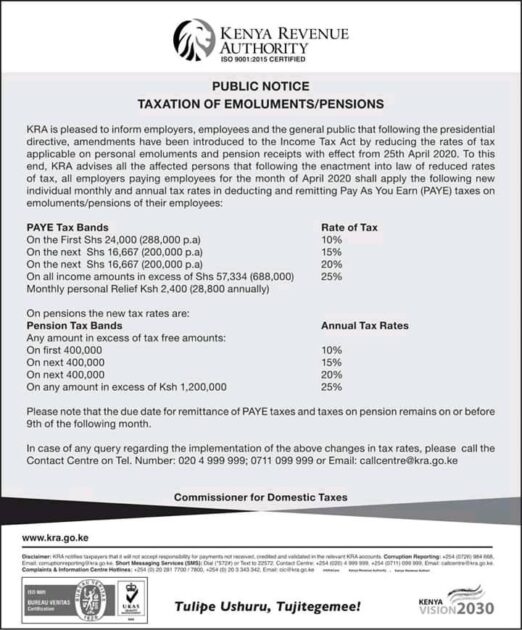
The new income tax bands as released by the Kenya Revenue Authority, KRA.
Read also:

Two learners to receive Sh5 million from TSC as defilement compensation

The Teachers Service Commission will be forced to pay a whooping sum total of Sh5 million Kenyan shillings as compensation to two pupils defiled by their head teacher. In a land mark ruling by court of appeal judges, the Commission should bear responsibility for failing to ensure safety of the learners while at school.

TSC had moved to the court of appeal to protest a ruling by high court judge Justice Mumbi Ngugi’s ruling that awarded the minors the compensation. Justice Mumbi had blamed the Commission for not instituting measures to safeguard the minors while at school. But, Court of Appeal judges Martha Koome, Roselyn Nambuye and Fatuma Sichale turned down the plea by TSC; and thus affirming Justice Mumbi’s ruling.

“As innocent victims, the minors are entitled to compensation for having been subjected to such humiliation, shame, and pain that may have a lifelong effect on them. It is inconceivable how the minors in their tender years are made to carry that kind of burden of shame due to selfishness of a caregiver,” said the Judges in a ruling read by Justice Martha Koome.

Astarikoh Henry Amkoah (a deputy head teacher at Jamhuri Primary School in Nakuru county) is said to have defiled the two minors on July 4 and 10, 2010; in his house. At that time the two girls were both in class six. In her ruling, on May 19, 2015, Justice Mumbi had found the teacher guilty.

“I award Sh2 million for the first girl and Sh3 million for the second girl who dropped out of school. I note that at the time the events the subject of this petition occurred, the petitioners were minors aged 12 and 13 respectively, and should now be aged 16 and 17 respectively. I therefore direct that the above awards, upon payment, be deposited in an interest-earning account in trust for them and be utilised to further their education or training with a view to their being able to make a sustainable living for themselves,” she ruled.

Justice Mumbi had urged the Commission to go an extra mile in dealing with sex pests at schools.

“With respect to the State through the TSC, it must up its game with respect to protection of minors. It cannot shuffle paedophiles from one school to another, and finally, content itself with dismissals. It has to put in place an effective mechanism, whether through an inspectorate department within TSC or the Quality Assurance Department within the Ministry, to ensure that no-one with the propensity to abuse children is ever given the opportunity to do so. Dismissal, and even prosecution, while important, can never restore the children’s lost innocence,” she added.

(Read the full ruling here; http://kenyalaw.org/caselaw/cases/view/109721/)

The awarded cash will be spent on the girls’ education until they complete their university studies.

The case was filed by two parents from Nakuru.

The Commission has been taking stern action against teachers accused of sexual harassment by serving them with dismissals.


BEST LINKS TO TSC SERVICES & DOCUMENTS; ONLINE

TSC hardship allowance rates and areas

The Teachers Service Commission, TSC, pays extra allowances (hardship allowances) to teachers working in areas classified as hardship. While classifying an area to be a hardship area, the locality must meet any of these conditions:

  • Lack of or unavailability or inaccessibility to food,
  • Inadequate transport and communication network,
  • Limited basic social services and amenities,
  • Persistent harsh climatic conditions like flooding, landslides and drought,
  • Insecurity and high possibility of security threats.

Hardship allowance is therefore paid in an effort to compensate for the cost of living for teachers working in areas designated as hardship. Like stated above, teachers working in hardship areas face a myriad of challenges; from lack of water, flooding to hostile living conditions characterized by constant spates of attacks.

Read also:
Hardship allowances

In December, 2014, the Salaries and Remuneration Commission, SRC, reviewed hardship allowance to be paid at a flat rate for all equivalent grades/ job groups. The Commission effectively abolished the pegging of the hardship allowance as a percentage of basic pay.

The table below summarizes the monthly hardship allowance rates that are paid to teachers working in hardship areas; per job group:

S/NO GRADE TSC SCALE FORMER JOB GROUP Hardship Allowance- in Kshs per Month
1 B5 5 G 6,600
2 C1 6 H 8,200
3 C2 7 I 10,900
4 C3 8 J 12,300
5 C4 9 K 14,650
6 C5 10 L 17,100
7 D1 11 M 27,300
8 D2 12 N 27,300
9 D3 13 P 31,500
10 D4 14 Q 31,500
11 D5 15  R 38,100


TSC designated hardship areas.

TSC has designated various areas as hardship. The areas considered as hardship include those that are prone to terrorism, famine and aridity. As of 2012, TSC had about 38 areas approved as hardship.

Currently, teachers teaching in schools located in some parts of the following counties receive monthly hardship allowances.

S/NO. AREA/ COUNTY
1 Garissa County
2 Isiolo County
3 Kilifi County
4 Kwale County
5 Lamu County
6 Mandera County
7 Marsabit County
8 Narok County
9 Samburu County
10 Taita Taveta County
11 Tana River County
12 Turkana
13 Wajir County
14 West Pokot County

THESE TEACHERS WILL CONTINUE MISSING SALARIES- TSC

The Teachers Service Commission (TSC) has released a list of teachers who are set to miss this month’s salary for failing to meet employment requirements. The list features newly employed teachers (who have not received any salaries, so far) for failing to submit their casualties.

According to the commission, a newly employed teachers must have his/ her casualty form filled by the head of institution and the teacher and then sent to TSC headquarters for appointment onto the payroll.

“Upon employment, the teacher is required to report to the duty station within two weeks from the date of posting. The head of institution should then  promptly submit a Casualty Return to the TSC headquarters,” reads the employment guidelines; in part.

Without the casualty form (see image below) being filled properly and sent to TSC, a teacher will not be put on the TSC payroll and will hence miss salaries.

TSC casualty form. Used by a newly employed teacher to apply for confirmation of appointment.

Most of those affected are intern teachers who were hired in November, 2019. By end of March, 2020 a total of 2,159 intern teachers were yet to be placed on the payroll.

“Some of these pending cases have either one or two documents missing or were not properly filed. Once that is done we shall have all of them on payroll,” TSC head of communications Beatrice Wababu had said.

RELATED NEWS
LIST OF TEACHERS WHOSE FILES ARE MISSING CAUSALITIES

The list at our disposal shows some close to 400 newly appointed teachers whose files are without casualties.

The list contains the affected teachers’ TSC numbers, names, work station and payroll processing status (indicating that the casualty has not been received). The TSC payroll is closed usually by 15th of every month and teachers can then receive their salaries from 20th, onward.

Meanwhile, the commission has commended teachers for being in the forefront in fighting the covid-19 pandemic.

“As the campaign against spread of Covid-19 enters a critical stage, we are happy with teachers’ compliance with government directives in this war,” says Wababu.

She adds that TSC is still offering services at headquarters and teachers can reach the commission via Email; info@tsc.go.ke or hotlines 0722208552 and 0777208552.

FRESH BID TO FORCE TSC TO SLASH, PAY SUBSISTENCE ALLOWANCES ONLY, OR REASSIGN DUTIES TO JUSTIFY TEACHERS’ PAY: LATEST TSC NEWS

FRESH BID TO FORCE TSC TO SLASH, PAY SUBSISTENCE ALLOWANCES ONLY, OR REASSIGN DUTIES TO JUSTIFY TEACHERS’ PAY: LATEST TSC NEWS

CHECK OUT SOME OF THE RIDICULOUS SUGGESTIONS OFFERED TO JUSTIFY TEACHERS’ PAY

Newspro media team has authoritatively established a move by key players to force the teachers’ employer, TSC to denounce its pledge to continue paying teachers’ salaries in full until schools reopen in January.

RELATED TSC NEWS;


TEACHERS MAY BE RECALLED TO MAN SCHOOLS


TSC TO SCRAP HARDSHIP ALLOWANCES FOR SOME AREAS


MAGOHA BEGS FOR OUTLAWED TUITION, WHY NOW? 


It appears that the recent announcement by the Teachers’ Service Commission to continue paying teachers’ salaries and implement the last phase of the 2017-2021 Collective Bargaining Agreement, CBA at the end of July 2020 (which will see some teachers, especially school administrators, earn higher salaries ) did not sit well with some key players.

Following the “big” announcement, some quarters were a beehive of activities deliberately aimed at ensuring the Commission slashes, pay subsistence only or reassign duties to tutors to justify the over 20 billion monthly pay for the next six months.

“As of now, there is no plan to stop paying teachers. This is because it is not the teacher who has refused to go to class; schools are closed due to Covid 19. If the teacher is called upon to resume teaching, they will do so the following day, so long as the conditions are right,” said Beatrice Wababu, TSC Director of Communications last week.

This is the announcement that seems to have opened Pandora’s box. Last week, social media was awash with complaints about teachers earning undeserved pay. What captured our attention was a deranged argument by Protus Onyango, dubbed “TSC employed teachers to continue enjoying their full pay despite being idle.”

This argument is not only scornful but also disrespectful to the teaching profession. Consequently, teachers termed the headline disparaging and inciting with some calling for a boycott of any Standard Newspapers and KTN News Channel until the media house apologizes for the misdemeanor.

In my opinion, this is a miscalculation by The Standard especially now that the media House signed a pact with one of the giant teachers’ unions, KNUT to allow teachers to subscribe for newspapers at a subsidized cost.

In the new deal, interested tutors would access all daily and weekend editions of The Standard Newspaper, The Nairobian, and other publications at a subsidized fee.


To read the full article, click on the following link
Standard, KNUT Deal Allows Teachers to Access Content at a Subsidized Fee


The war against teachers’ full pay did not however end with The Standard Media reporter Protus Onyango. Major players have now jumped the bandwagon to force TSC to pay teachers subsistence allowances as opposed to full pay or an alternative be sought to justify teachers’ pay. Otherwise, the continued pay will amount to stealing from the public coffers.

Subsistence allowance refers to money paid to workers for basic needs like food, housing, etc. popular TV and radio stations are suggesting that it is wrong for teachers to continue earning while doing nothing. They have now shifted the blame to the teachers’ employer, TSC for paying “idle” employees.

This heightened debate has culminated in ridiculous suggestions such as reassigning teachers’ roles so that they may be used in other national projects like bridge and road constructions.

Others suggest that teachers be used in mitigating the effects of covid 19 such as increased teenage pregnancies.

Our take right now is clear. The debate on whether teachers’ salaries should be paid is uncalled for and malicious. Remember that teachers get paid money that is only enough to sustain them, unlike reporters who can easily invest without necessarily applying for loans. Most teachers cannot afford luxury suites like Protus Onyango and the rest. So please, leave teachers alone. Just like the TSC put it, TEACHERS HAVE NOT REFUSED TO GO TO CLASS. IF CALLED UPON TO RESUME TEACHING, THEY WILL DO SO THE FOLLOWING DAY, SO LONG AS CONDITIONS ARE RIGHT!


Kind teachers contribute Sh2 billion towards the covid-19 response fund

Teachers contributed a total of Sh2.4 billion towards the National Emergency Response Committee on Coronavirus. The commission had early on urged teachers to willingly make their contributions towards the kitty. After closure of the May payroll, the commission announced that it had received a total of Sh2,441,028 from the over 300,000 teachers on its payroll.

The Commission has raised a total of Sh10,696,024 in the last two weeks. The Kenya Secondary Schools Heads Association, KSSHA, recorded the largest contribution after raising a whooping Sh5 billion. Other contributors were: the Kenya college Principals (Sh2 billion), and the TSC Secretariat staff (Sh1.6 billion).

TSC  had initially made a direct contribution of Sh400,000.

Also read;

These figures are contained in a memo by the TSC boss Dr. Nancy Macharia dated May 15, 2020 and addressed to the chairperson National Emergency Response Committee on Coronavirus.

The voluntary salary cuts shall be for an initial period of three (3) months with effect from April, 2020. However, this is subject to review based on the advice of the Ministry of Health on the status of COVID-19 pandemic in Kenya. contributions can be made either directly or via the TSC check-off system; with authorization from respective teachers. Each public officer participating in the voluntary salary cuts shall signify their consent to their respective Authorized Officers by completing the attached standard consent form.

The President and his deputy took a pay cut of 80%. While, Cabinet secretaries and Chief Administrative Secretaries are to take a voluntary pay cut of 30%. Principal secretaries on their part can give away 20% of their salaries to support the fund.

The raised funds will greatly boost the committee’s efforts in fighting the pandemic that has paralyzed most operations in the country. The committee was established by President Uhuru Kenyatta on April 28, 2020 and is chaired by the health cabinet secretary Mutahi Kagwe.

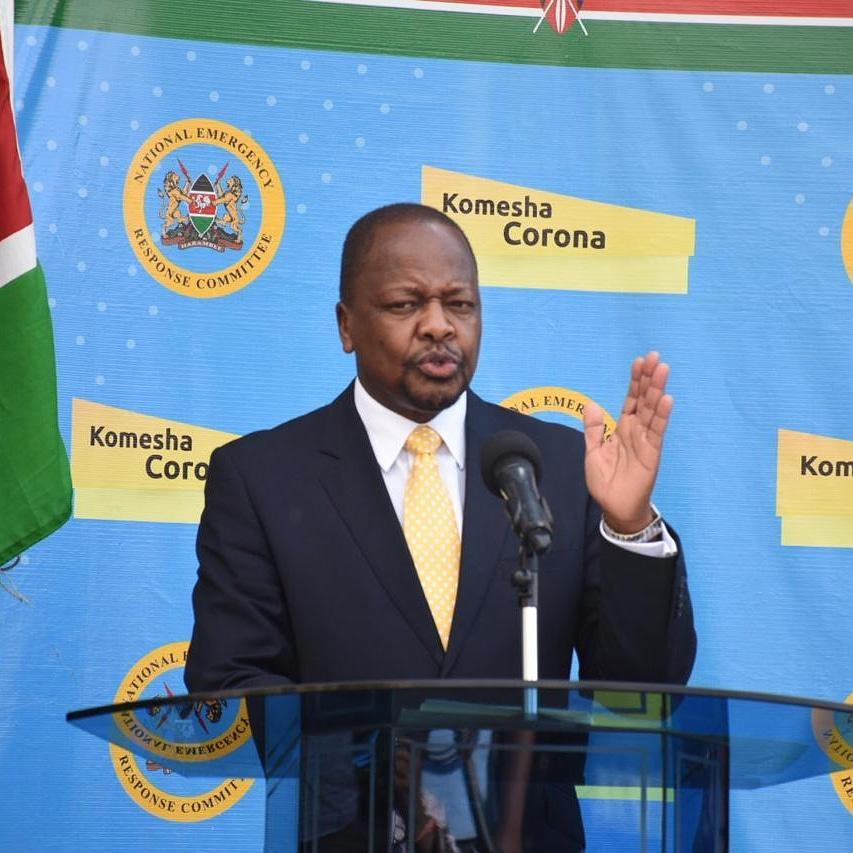
Hon. Mutahi Kagwe who is the Health Cabinet Secretary and also chair to the National Emergency Response Committee on Coronavirus.

This is what you must know about TSC teachers’ salaries

The Teachers Service Commission, TSC, employs and pays teachers their monthly salaries plus allowances. The teachers’ pay is usually processed and paid as from 22nd of every month and onward. Once you are newly employed, the commission will appoint you to the payroll and you start earning as soon as your casualty form is received at the TSC head quarter and your file processed. The salaries are disbursed to teachers’ pay points; Banks or SACCOs.

Some teachers have committed unprecedented and irreversible financial mistakes that they live to rue for the rest of their teaching careers. These mistakes usually occur during the teacher’s hey days; when newly employed. Most teachers get employment when still young, enthusiastic and energetic. Some have ended up squandering the opportunity to invest well and spend their monies wisely leading to many years of cursing; the resultant effect being depression.

SEE ALSO;

Here are 10 points for your quick guidance. You must not follow all that is stated here, but some how you will get some insight.

  • NEVER OVER COMMIT YOUR PAYSLIP

When going for loans and savings, remember to give your payslip some breathing space. Long before the a third rule came, some teachers (and not only teachers but other civil servants too) used to walk home with net negative pay. This prompted the government to come up with the 1/3 rule. It is thus advisable to have some amount off and above your net pay; so that in case of an emergency then such amounts can come in handy in terms of securing an emergency loan.

  • WISE CHOICE OF INVESTMENTS

It is the aspiration of everyone that they at least have some investment. In fact, investments are good not only for the immediate gains but also during your sunset years. But, some investments are not worthwhile. With your first pay and/ or loan go for income generating assets/ activities or assets whose value appreciates with time like land. Unless you have other sources of income/ side hustles otherwise never rush for such luxurious assets like cars. Yes, cars are good but if your payslip is stifled up to the neck how will you maintain that car? Start a business, get a side hustle to supplement your pay. Take risks, be a go-getter.

  • AVOID ‘BAD’ LOANS

Do not be too quick to rush for bank loans. All that glitters is not gold! yes, with banks you can get your loan after just three months of service and you do not need to save for you to qualify for a loan. Before the interest capping rule came banks could adjust their interest rates at free will. You take a loan at 18% interest rate and it is adjusted to 22% the next day! And now that the capping law is gone, it spells more gloom for borrowers who will now operate at banks’ mercies. Bank loans are damn expensive with a myriad of hidden charges!

And, be nice Mwalimu. You let friends sign your SACCO loan form and then disappear into thin air leaving them in awe!

  • BUILD YOUR CAPITAL BASE SLOWLY

Never be in too much hurry some times. Build your capital base slowly and patiently. do not be too quick to be carried away by what you see. A colleague bought a car yesterday and you want to rush to the showroom the next morning! Mwalimu (teacher), be rational in your thinking.

  • TOP-UP LOANS IS A BIG NO.

Avoid top up loans, more so from banks, like leprosy. Consider this pathway when you are in a can’t avoid scenario. Banks will entice you to go for top ups. but, this will be a like a financial death sentence. You will be enslaved to these banks forever.

  • LIVE WITHIN YOUR MEANS

Cut a cloth according to your size. Not, because a colleague is driving a hot car and you also covet it! Do not borrow more than you can repay! Have your plans within your financial ability. Avoid big plans that may cause depression and anxiety to you.

  • SAVE! SAVE! SAVE!

Have a saving plan. Save even Sh100 bob monthly. Such small savings turn into humongous things slowly and without you realizing it. SACCOs are the best saving bets for a start.

  • ALL IS NOT ROSY AT ALL TIMES!

The early years of your employment are always glittering; in terms of ‘good’ pay. Then, your salary is not committed as such. This is followed by a quick common cadre promotion. You move to the next job group with a marginally increased perks. Wait until deductions get their way into your payslip! What follows is hell on earth; you stagnate in the same job group for a long time. And, if you were not born on a Friday, luck will be so elusive that you end up retiring in the same job grade!

  • JOIN TEACHERS’ UNIONS

Do not see teachers’ unions as bothers. Those guys are very helpful when the waters become murkier and the going is tough. It would be need;less for you to be on agency fee (where you contribute money to the unions but you are not a member!). The TSC code of regulations and conduct is harsh, very harsh. You may find yourself on the wrong side of the code, by design, hard luck, coincidence or mere fabrication. That is when you realize the importance of teachers’ unions.

  • BE A MEMBER OF SOME WELFARE GROUP

There is a slogan that goes ‘UNITED WE STAND, DIVIDED WE FALL’. Do not be an island. Belong to some teachers’ welfare. There are so many out there. the common ones are BBFs (Burial Benevolent Funds). Above all, make connections. Have friends and social connections. AVOID UNNECESSARY CONFRONTATIONS AT YOUR PLACE OF WORK. Be aggressive. Apart from teaching, participate in one or two co-curricular activities. Drama, Music, Ball games, athletics… name it.

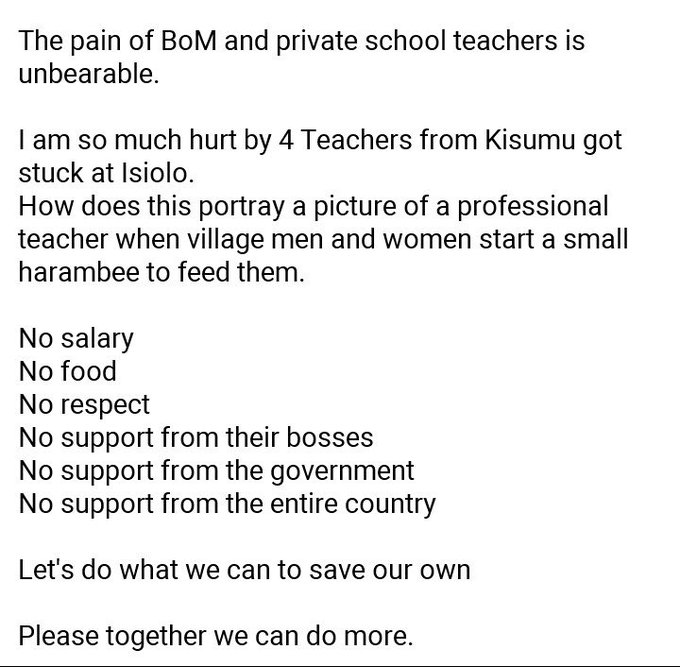
Teachers’ salaries: Who will save private and BOM teachers?

If you thought you are suffering due to the covid 19 pandemic as a result of the ripple effects caused by the covid 19 pandemic and you are still earning, just sit back and think of millions of Kenyans who have lost jobs or whose pay has been suspended. This is the scenario facing the teachers employed by Boards of Management (BOMs) and private schools. Days, and now months, have passed without these teachers laying sight on their salaries.

Imagine having a family to support, a myriad of basic needs to meet and to make matters worse living in a town (with no side hustle!). This is like living in hell on earth.

The last time some of these teachers earned was back in December, 2019! And with schools closed as a result of the covid 19 pandemic it has become practically impossible for school heads to meet the salary demands for the tutors plus other support staff. School management boards have since sent them on unpaid leave; until normalcy reigns.

Attempts by these teachers to have the attention of the education ministry’s cabinet secretary have been an exercise in futility. Elected leaders have turned a deaf ear on them.

GOVERNMENT FUNDS FOR VULNERABLE GROUPS

The government has been disbursing Sh1000 weekly to each family under the government cash transfer program for those identified as vulnerable. The cash is to enable them meet their basic needs during the period of the COVID-19 pandemic. There have been calls to integrate BOM and private schools’ teachers into the programme.

Going without cash for close to one year (given that the earliest schools can be reopened is September) is tricky. Someone needs to come to the aid of these teachers.

KUPPET WADES INTO BOM TEACHERS’ SALARY CIRCUS

The Kenya Union of Post Primary Education Teachers (KUPPET) has waded into the debate; asking the government to pay the over 72,000 teachers working on BOM terms.

“Since the first case of Covid19 in Kenya was announced on 13th March 2020 subsequent closure of schools on 15th March 2020, about 72,000 workforces of teachers comprising of what is commonly referred to as Board of Management (BOM) teachers lost their jobs,” says kuppet national chairman Omboko Milemba.

He wonders why the ministry of education ordered for the reimbursement of Sh720 million unused activity money that had been sent to public schools; adding that the money could have been utilized to pay salaries for staff at school level.

A screenshot showing how BOM teachers are suffering, silently.

Cash for the BOM teachers has been coming through the ministry’s fees capitation. And since the money is budgeted for, it would be prudent for the government to release the portion of the Personal Emoluments vote head to cushion the BOM staff.

Also read;
KENYANS ONLINE ROUTE FOR PAYMENT OF BOM TEACHERS’ SALARIES

Here are sampled comments on salaries for BOM and private schools’ teachers (as shared on social media);

Irony Lady: “Its so sad seeing private and BoM teachers sink into depression. November and December they weren’t paid. Reason schools closed early and salary depends on school fees. From march up to date reason salary depends on school fees and corona. Why us?”

Mayaka Zachaeus: “The situation for BOM and private school teachers is worse than COVID 19.”

Chela: “The government has neglected hardworking teachers who are under BOM and Private schools. President Uhuru Kenyatta and ministry of Education should intervene on this since they are helping a Kenya child.”

Ng’iela David:BOM as well as PTAs have employed over 500k teachers. Majority of these ,have not received salaries. We request to be included in the list of the vulnerable Kenyans.We can no longer offer our services in this country.Not even to our neighbour’s kids.”

Pius Sigei: “Mr president, kindly listen to everyone who is at distress during this Covid19 pandemic more so BOM teachers and those who teach in private schools. Please and kindly.”

F. Onyango:Mr President please mind BOM and Private school teachers.They are also booster of Kenyan economy.”

TSC teacher’s pay from the T-pay portal https://payslip.tsc.go.ke/

The Teachers Service Commission, TSC, payslip is a monthly generated document that shows the much a teacher earns. The payslip is generated from the TSC payroll and can be downloaded from the TSC payslips portal (T-pay) by using the address https://payslip.tsc.go.ke/.

The payslip contains such crucial information as the teacher’s monthly gross pay, allowances and deductions. deductions from teachers’ pay include: Statutory deductions (like Pay as you earn -income tax, National Hospital Insurance Fund- NHIF) and third party deductions.

Teachers remit various amounts to third parties that include teachers’ unions, SACCOs and other deductions. The difference between third party deductions and statutory deductions is that third party deductions are not necessarily mandatory while statutory deductions are mandatory.

You can for example opt out of a deduction towards a Burial Benevolent Fund (BBF) but the same can not happen for individual income tax.

COMPLETE DETAILS ON THE TEACHER’S PAYSLIP

YOUR payslip contains basic information as: the month and year, TSC Number of the teacher, Teacher’s name, Teaching Station, Retirement date, The teacher’s job group/ grade/ designation, ID Number, KRA Tax PIN, the employment terms (either probationary or permanent & pensionable) and the number of years to retirement.

Other details shown on the payslip are: The paypoint (Bank or SACCO name through which salary is remitted), Basic Salary, Allowances (Rental House, Commuter, Special, Hardship as appropriate), Total earnings, Third party deductions (Loans, insurance, medical cover, PAYE, NHIF and other deductions from the teacher’s gross pay), total deductions and then the teacher’s net pay for that particular month.

You can be able to access all your payslips, online, by setting the year and month on the payslips’ home page.

REGISTRATION FOR ONLINE PAYSLIPS AND THE LOG IN PROCESS

A teacher must first be registered in order to get his/ her payslips online. Initially the process was done online but, now you must visit your local TSC County office for you to be registered. To log into your T-pay account all you need is your TSC Number and Password.

Once registered you can then proceed to log into the T-pay system to view your payslips and P9 forms. The system also provides a function for teachers to send their latest pay slip to 30 parties such as banks, Saccos, among others, to facilitate acquisition of a loan.

SEE ALSO;
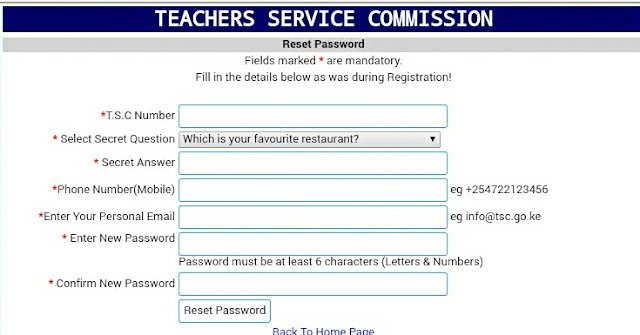
HOW TO RESET YOUR T-PAY PASSWORD.

You can also easily reset your T-pay password. This can be achieved by following the simple steps below;

  • Visit the payslips portal at; https://payslip.tsc.go.ke/
  • Click on the ‘Forgot password’,
  • Fill in the required details; (TSC Number, Select the secret question, provide the answer, enter your phone number, email and password)
  • The click ‘Reset Password’.
Resetting your TSC T-pay password.

In case you have any queries or need any assistance, then you can send an email to: payslips@tsc.go.ke or call +254 020 289 2158.

Employing TSC intern teachers on permanent and pensionable terms. Way forward?

The Teachers Service Commission, TSC, opted to recruit teachers on an internship programme in a bid to address the teething staffing gaps in public primary and secondary schools. This programme would see intern teachers hired to work along the ones on permanent and pensionable terms. whereas both categories execute similar teaching tasks, the monthly perks for teacher interns are much lower compared to their counterparts on permanent terms.

Intern teachers working in secondary schools receive a gross pay of Sh15,000 per month while, those in primary schools pocket Sh10,000. This pay is subjected to further deductions like income tax and the national hospital insurance fund (NHIF). Those paying student loans to the higher education loans board (helb) receive much lower salaries.

The lowest paid teacher on permanent terms earns a monthly gross pay of between Sh25,692 (minimum) and Sh30,304 (maximum). While, the highest paid teacher pockets over Sh200,000 per month.

Also read; TSC Teacher Interns: TSC and Government got it wrong

The commission employed over 10,000 interns recruited in November 2019 and who have been hoping that they would one day be absorbed permanently. Their contract runs for one year; up to November, 2020.

Pressure has been mounting on the teachers’ employer to give the intern teachers permanent jobs. In December, last year,a group of lawyers took TSC into task over intern teachers’ contract terms and salaries. Also, members of parliament have been against this idea of employing teachers on internship.

Whereas the teachers are free to apply for permanent slots, these slots are just a handball and their advertisements are equally far between.

TSC projects a teacher shortage of close to 50,000 teachers in primary schools alone. The situation is equally wanting in secondary learning institutions as a result of the influx of large numbers from primary schools.

Employing contract teachers on permanent basis. Which way the TSC?

In its 2020/ 2021 budget estimates, the commission says a total of Sh2.1 billion is required to employ more teachers. According to the TSC Chief Executive Officer, Dr. Nancy Macharia, the funds will be utilized to employ 5,000 teachers on permanent terms and other 10,000 teachers on the internship programme.

“The funds are estimated to employ 5,000 new teachers for seven months and 10,000 interns for nine months,” Dr. Macharia recently told a parliamentary committee on education.

So, where does this leave the current interns? This is the mind boggling question lingering in the over 10,000 teacher interns.

Truth be said, the commission is not considering to absorb the current group of teacher interns as there are no budgetary allocation for the same; as at now. According to Dr. Macharia, the commission is projecting to recruit about 40,000 more tutors; and again on internship. If TSC decides to absorb the interns permanently (which will be a good thing) then it will be a big sigh of relieve for those currently on contractual terms. In 2010, for instance, it had to take the intervention of parliament for the interns to be absorbed. In the subsequent employments the teacher interns were awarded an extra marks range to give them an edge over others. The current recruitment guidelines haven’t included such a provision. The recruitment guidelines and marking schemes give more weight to teachers who graduated earlier.

A voice of reason somewhere should listen to the cries of intern teachers; sooner than later.

TSC marking scheme for teachers used during the recruitment process.
TSC marking scheme for teachers, used during the recruitment process.

PRIVATE SCHOOL TEACHERS APPEAL FOR STIMULUS PACKAGE, CITING LACK OF BASIC NEEDS DESPITE STUNNING PERFORMANCE IN NATIONAL EXAMS; LATEST EDUCATION NEWS

PRIVATE SCHOOL TEACHERS APPEAL FOR STIMULUS PACKAGE, CITING LACK OF BASIC NEEDS DESPITE STUNNING PERFORMANCE IN NATIONAL EXAMS; LATEST EDUCATION NEWS

By the time schools gradually re-open in September 2020, private school teachers and their BOM counterparts will have been baptized through the fire, gone to hell by foot, and tested the wrath of the harsh economic realities catapulted by the Covid-19 pandemic. What plan does the government have for them?

Teachers employed by private schools in Kenya have tested the wrath of hunger and lack of basic needs since their salary accounts have been” yawning” for almost three months now.

What is even worse is the lack of a stimulus package for these tutors whose families depend on these salaries.

According to the Kenya National Union of Private Schools Teachers (KNUPST) Secretary-General Dan Khisiani, the majority of teachers in private schools have been left to their own mechanisms ever since President Uhuru Kenyatta announced the closure of all educational institutions in Mid-March.

These tutors are yet to receive their three-month salaries. The worst part of it all is the lack of a clear plan on how to support them during this Covid-19 period.

RE-OPENING OF SCHOOLS

Even though the President announced a gradual re-opening of schools in September, Mr. Khisiani does not see how this could help salvage this dire situation.

Besides, September is far-fetched. By the time schools reopen, these teachers would have been baptized by fire following the harsh economic realities stimulated by the spread of the pandemic.


PRIVATE SCHOOLS’ TEACHERS REQUEST FOR AN ECONOMIC STIMULUS PACKAGE

KNUPST now wants the Government to consider the inclusion of private school teachers in the country’s economic stimulus package.

Khisiani further lamented that the teachers and their counterparts employed in public schools by schools’ management boards, BOM teachers work in very tough, horrendous conditions, produce top students in KCSE and KCPE national exams but no one seems to acknowledge the indispensable roles they play.

He regretted that many private schools have now turned their backs on these teachers when they need them most.

“By the time schools reopen, these teachers shall have gone for six months without salary! This, therefore, means that these teachers shall lack basic needs for all that duration,” said KNUPST Secretary-General.

CRITICAL ROLES

Statistics indicate that these private schools play a critical role in the Kenyan education sector.

Besides producing top KCSE and KCPE candidates, these schools have plugged the infrastructural and staffing gaps in the sector.

It is in the public domain that most public schools in Kenya are over-populated leading to a teacher: learner ratio of 1:50, a factor that is likely to water down the quality of education these learners receive.

Currently, there are over 10, 400 private primary schools with approximately 2.14 million pupils and at least 1, 627 private secondary schools with over 271, 618 students.

Already, private schools through their association have appealed for government grants to keep their schools afloat.

It seems that their move was not well-calculated. Or was it their reasons that did not appeal to the humane side of those charged with the responsibility of issuing these stimulus packages?

Anyway, they have done their part; it is now Khisiani’s turn but before I wind up, allow me to share my sentiments since if I don’t, I will be doing a disservice to humanity especially to BOM and private school teachers.

MY QUESTION IS QUITE SIMPLE: DOES IT MEAN THAT THESE TRAINED PROFESSIONALS’ ROLES OF IMPARTING KNOWLEDGE, SKILLS, AND VALUES TO OUR CHILDREN CANNOT SURPASS THAT OF MUSICIANS?  


TSC TO SLASH P1 TEACHERS’ PAY; HUGE SALARY CUTS AWAIT TEACHERS, ESPECIALLY P1 TUTORS FOLLOWING IRREGULAR PROMOTIONS, TSC SHEDS MORE LIGHT; READ THE ACTUAL TSC CIRCULAR ON TEACHERS’ PROMOTIONS BELOW

TSC TO SLASH P1 TEACHERS’ PAY; HUGE SALARY CUTS AWAIT TEACHERS, ESPECIALLY P1 TUTORS FOLLOWING IRREGULAR PROMOTIONS, TSC SHEDS MORE LIGHT; READ THE ACTUAL TSC CIRCULAR ON TEACHERS’ PROMOTIONS BELOW

HOW CAN P1 TEACHERS EARN A SALARY EQUIVALENT TO THAT OF SECONDARY SCHOOL TUTORS?

TSC TO SLASH P1 TEACHERS’ PAY; HUGE SALARY CUTS AWAIT TEACHERS, ESPECIALLY P1 TUTORS FOLLOWING IRREGULAR PROMOTIONS, TSC SHEDS MORE LIGHT; READ THE ACTUAL TSC CIRCULAR ON TEACHERS’ PROMOTIONS BELOW TSC SHEDS MORE LIGHT ON THE ERRONEOUS, IRREGULAR PROMOTION OF TEACHERS TO UNDERSERVED GRADES (JOB GRADES)


It is now crystal clear that some teachers especially those in primary schools are staring at imminent huge salary cuts after they were irregularly promoted to grades with higher salary perks during the implementation of the 2017-2021 CBA.

Earlier, we did an article on TSC promotions that highlighted some of the anomalies and how they came to be. Below is the link to the article

TSC IRREGULARLY PROMOTED SOME TEACHERS ESPECIALLY P1 TUTORS IN 2017


TSC SHEDS MORE LIGHT ON THE ERRONEOUS, IRREGULAR PROMOTION OF TEACHERS TO UNDERSERVED GRADES (JOB GRADES)


Fresh details have emerged shedding more light on which teachers are likely to be greatly affected by the upcoming TSC salary cuts.

According to the Commission, several primary school teachers have been earning, more than they should with some earning a salary equivalent to that of secondary school teachers.

This is very absurd and quite demotivating to high school teachers since a teacher’s salary should be pegged on the teacher’s work output, job designation, and academic qualifications.


PROMOTIONS BY PRESENTATION OF PAPERS

After a thorough analysis of data presented before the Commission in 2017 has revealed that some regular classroom P1 teachers have been earning salaries higher than their designation. Some P1 teachers are said to have been earning salaries equivalent to that of school administrators and some school administrators earning a salary equivalent to that of their counterparts in secondary schools.

There have been numerous complaints about the criteria used to promote teachers. Some tutors especially secondary school teachers in Grade C3 former L felt cheated by the system since the Commission does not advertise promotional vacancies for the grade.

This has unfortunately seen the majority of these teachers stagnate in this grade for over 15 years.

THE BIG QUESTION ON MANY TEACHERS’ MINDS IS, HOW IS THIS EVEN POSSIBLE?

The world is a funny place and full of possibilities too. According to the circular, this anomaly arose some three years back when the commission decided to promote teachers by simply presenting papers instead of following the right protocol.


TSC CIRCULAR ON CONFIRMATION OF INSTITUTIONAL ADMINISTRATORS

Now that the Commission is set to promote and effect salary increments of teachers on July 1, 2020, all field officers have since been directed to confirm data for all school administrators who were on duty as of June 30, 2020.

“Before the implementation of the current CBA, on 1st July 2017, you were instructed to validate the data for institutional administrators who were on duty as of 30th June 30, 2017.

TSC SHEDS MORE LIGHT ON THE ERRONEOUS, IRREGULAR PROMOTION OF TEACHERS TO UNDERSERVED GRADES (JOB GRADES) TSC TO SLASH P1 TEACHERS’ PAY; HUGE SALARY CUTS AWAIT TEACHERS, ESPECIALLY P1 TUTORS FOLLOWING IRREGULAR PROMOTIONS, TSC SHEDS MORE LIGHT; READ THE ACTUAL TSC CIRCULAR ON TEACHERS’ PROMOTIONS BELOW

The validation exercise was extended to ensure that only teachers serving as institutional administrators were converted as such on the effective date of CBA. It has been established that some of you provided inaccurate and misleading data leading to erroneous conversion…” reads part of the circular.

SENSITIVE DATA

Given the sensitivity of this matter, the TSC has since directed all county education officers to personally collect the data afresh and submit it to the TSC headquarters by June 30, 2020.

The exercise should be closely supervised and counter-signed by the regional education director in person for verification purposes.

Furthermore, schools with excess institution administrators should be earmarked so that the extra administrators can be deployed to other stations.


Teacher deficits per county: TSC News

Kakamega county has the highest teacher shortage in the country. This is according to the latest data provided by the Teachers Service Commission, TSC. The Western region county, Kakamega, needs about 3,544 more teachers in order to attain its curriculum based establishment (CBE).

Bungoma county, also from the western region, has a shortfall of 2,813 teachers while Bomet county (from the Rift Valley region) requires an extra 2,813 tutors.

Kirinya county (in the central region) has the lowest teacher deficit as it requires only 30 more teachers.

TSC says primary schools currently have a total of 211,046 teachers out of  the required number of 259,219. This gives a shortfall of 48,173 teachers in the whole country.

Related news
Table: Staffing gaps for primary school teachers per county
S/NO COUNTY TEACHER SHORTAGE
2 Kakamega county 3,544
7 Bungoma county 2,813
9 Bomet county 2,813
8 West Pokot county 2,489
10 Narok county 2,272
12 Homa Bay county 1,897
13 Turkana county 1,762
14 Kwale county 1,571
15 Migori county 1,495
16 Nandi county 1,441
17 Siaya county 1,438
18 Makueni county 1,398
19 Busia county 1,381
20 Mandera county 1,125
21 Kajiado county 1,000
22 Kisumu county 969
23 Baringo county 907
24 Machakos county 897
25 Kisii county 848
26 Wajir county 847
27 Trans Nzoia county 844
28 Vihiga county 762
29 Kericho county 727
30 Meru county 705
31 Garissa county 687
32 Tana River county 462
33 Marsabit county 460
34 Murang’a county 423
35 Embu county 367
36 Elgeyo Marakwet county 347
37 Tharaka Nithi county 336
38 Nyandarua county 329
39 Nyeri county 321
40 Samburu county 315
3 Laikipia county 241
4 Mombasa county 229
5 Lamu county 113
6 Isiolo county 78
1 Kirinyaga county 30


In terms of percentage shortfalls, Kirinyaga, Kiambu, Uasin Gishu, Nyeri, Nyandarua, Murang’a, Meru, Laikipia, Isiolo, Elgeyo Marakwet, Embu and Nairobi have the least shortage of teachers. Kakamega, Kitui, Bungoma and Nakuru have the highest percentage shortfalls.

Dr. Nancy Macharia the TSC CEO. She says the country is faced with a shortfall of about 50,000 primary school teachers.

The commission says it has become difficult to address the teething gaps due to budgetary constraints. The commission has since started employing teachers on internships (alongside those on permanent and pensionable terms) to try and address the shortages. This is because lesser funds are required to enlist teachers’ services under the internship programme as opposed to the permanent and pensionable terms. The redeployment of teachers from primary to secondary schools has further created staffing gaps in the primary schools.

The commission uses set recruitment guidelines to ensure fairness during the process of employing new teachers. read the latest guidelines here; TSC Teachers’ mass recruitment guidelines and marking scheme.

SALARIES: BETRAYAL, EMPTY PROMISES AS BOM TEACHERS GET A RAW DEAL FROM SCHOOLS

SALARIES: BETRAYAL, EMPTY PROMISES AS BOM TEACHERS GET A RAW DEAL FROM SCHOOLS

External links with related content

CS Magoha’s announcement that the government will soon release free education funds to help schools meet costs such as paying BOM staff salaries rekindled the hope of many BOM teachers who had gone without pay for over five months now.

However, the joy seems to have vanished as soon as it had come given the indifference that some BOM teachers have been treated to this week.

As promised by Professor Magoha, the funds did hit the school accounts. If my memory serves me right, part of that cash was meant to pay subordinate staff such as security personnel and teachers employed by school boards of management.

“The government has set aside sufficient funds to pay Board of Management teachers, non-teaching staff including security personnel to ensure proper maintenance and safety in schools,” said  Magoha in a press briefing.

The funds were deposited in school operations accounts between August 3 and 5, 2020. A spot check by our media team shows that no disbursement was made for the tuition account now that learners are not in school.

“All the requisite funds have been released to schools. Therefore, it is expected that the support staff will continue receiving their wages,” confirmed Magoha last week.

The ministry used data in its National Education Management Information System, NEMIS to determine what each school will get.

Every secondary school learner got Sh 3, 725 in the latest disbursement by the education ministry. Ina year, every learner in all public schools receives sh 22, 244 through the free day secondary education. Part of this money, Sh9, 400 is deposited into the school’s operations account which encompasses personal emoluments such as BOM staff salaries.

The disbursement is usually done in the ration 50:30:20 for terms 1, 2, and 3 respectively.

BOM TEACHERS, STAFF BETRAYED IN SALARY DEAL

Now that the free education funds hit the schools’ operations accounts, many embarked on paying salaries to BOM teachers and subordinate staff.

What is shocking is the fact that some schools opted to pay part of the July salaries, writing off unpaid balances.

If the government released full funds, why should schools pay part of the salaries and write off the balances?

One of the teachers whose identity we will not reveal for fear of being victimized revealed the rot in schools. According to him, he earns a monthly salary of sh 14, 000 but the school only deposited Sh 7, 000 into his account.

Attempts by the teacher and our media team to reach the principal to address the matter have been futile.

“My monthly salary is sh 14, 000 but I have only received sh 7, 000.  Attempts to reach the principal have been futile with his phone going unanswered or off,” confessed one of the affected teachers.

HALF SALARIES, UNPAID LEAVE

In another school, BOM teachers have been informed that they will receive half salaries for August after which they will proceed on unpaid leaves till schools reopen.

“Subject to a BOM meeting held on August 4, 2020, it was decided that you will be paid half salary in August 2020. From September 1, 2020, you will proceed on unpaid leave until such a time when the ministry gives further instructions on reopening(dates) of schools,” read part of the school’s memo.

This was expected given the way CS Magoha refused to commit to paying BOM teachers’ salaries. Last week he distanced himself from the matter, saying that it was upon schools to pay their BOM staff since they are not employed by the ministry.

It is therefore not clear whether schools will or should pay all salary arrears owed to BOM staff. To make matters worse, no ministry official is willing to commit to paying the salaries. So where does this leave BOM staff and teachers?


REPRIEVE FOR BOM TEACHERS AS CS MAGOHA GETS SUMMONED BY PARLIAMENT OVER FREE PRIMARY AND SECONDARY SCHOOL CASH DELAYS

HOPE FOR BOM TEACHERS AS CS MAGOHA GETS SUMMONED BY PARLIAMENT OVER SCHOOL CASH DELAYS

Education CS Professor George Magoha has been summoned to appear before the Parliamentary education committee to explain why the Ministry is yet to disburse 30% of second term funds for free primary and secondary schools across the country.

This noble idea was fronted by Emuhaya MP Omboko Milemba who asked Parliament to summon the CS to explain when the ministry will release the funds to support the education sector which is obviously struggling like the other sectors amidst the pandemic.

“It is about three months since teachers who are employed by the boards of management and other non-teaching staff were paid yet they play a critical role in the education sector,” said Milemba.

The aforementioned 30% figure is meant to help schools facilitate their activities.

CO-CURRICULAR ACTIVITIES’ FUNDS

In May 2020, the Ministry demanded that county and sub-county education directors return all unused money allocated for co-curricular activities now that they did not take place following the outbreak of the coronavirus in March 2020.

Milemba now wants millions of shillings that had been allocated to the ministry for curricular activities to be reallocated to schools to help in off-setting some outstanding debts that schools may have accrued following the unexpected closure of schools.

BOM TEACHERS’ SALARIES

According to KESSHA chair Kahi Indimuli, approximately 80, 000 teachers employed by school management boards and thousands of subordinate staff in public schools have not received their monthly wages since April 2020 due to the delayed release of funds to schools.

Their counterparts in private schools have not been spared either. As we speak, most private schools are engaged in battles with parents and guardians over school fees payment to maintain their staff.

“It has been three months now and BOM teachers, subordinate workers, and tutors in private schools seem to have been totally forgotten. Currently, there is a glaring staffing gap of 120, 000 teachers. BOM teachers together with their counterparts in private schools have families that depend on them,” said Milemba, KUPPET chair.

EXTRA-ORDINARY TIMES CALL FOR EXTRAORDINARY MEASURES

Mr. Milemba said that these were extraordinary times and therefore the Ministry should deal with its workers in an extra-ordinary way that is humane and considerate.

Mr. Indimuli backed up Milemba’s take asking the government to release the funds saying that BOM teachers and subordinate staff earn a pitying and therefore denying them salaries will complicate their lives since the majority have got families that depend on them.

When contacted by the Daily Nation, CS Magoha did not respond to text messages or calls on what the Government has done to address the plight of BOM teachers.


TEACHERS’ SALARIES MUST REMAIN INTACT, GOVERNMENT WARNED

TEACHERS’ SALARIES MUST REMAIN INTACT, GOVERNMENT WARNED

TEACHERS' SALARIES MUST REMAIN INTACT, GOVERNMENT WARNED

The Kenyan Government has received a stern warning against any attempts to slash tutors’ salaries in Kenya.

External links with related content

This stern warning comes even as the Teachers Service Commission in March 2020 assured teachers that they will continue receiving their full salaries during this era of the coronavirus pandemic.


Read also: TSC promises not to slash tutors’ salaries

SOSSION WARNS TSC AGAINST SLASHING TEACHERS’ SALARIES

Speaking at a press conference during the launch of the Covid- 19 education response’s report on mitigation measures and recommendations on schools’ reopening, KNUT Secretary General Mr. Wilson Sission issued a red alert to both the Government and owners of private schools regarding teachers’ salaries.

Sossion said that teachers’ salaries must remain intact at whatever cost.

“The salaries of teachers must be protected. No one, whether government or private entities, should use Covid-19 to hold the salaries of teachers,” said Sossion.

READ ALSO

SCHOOLS TO REOPEN IN SEPTEMBER, KCSE & KCPE BE POSTPONED UNTIL FEBRUARY 2021; COVID-19 EDUCATION RESPONSE TEAM RECOMMENDS

TSC TO PROMOTE 100, 000 P1 TEACHERS

KCPE, KCSE EXAMS ARE OVERRATED,  RAILA CONFIRMS

TSC TO EFFECT ANNUAL SALARY INCREMENT IN JULY 2020


BOM TEACHERS TO WAIT  LONGER FOR THEIR APRIL & MAY SALARIES

Despite Mr. Sossion’s warning, teachers employed by Boards of Management in various schools popularly referred to as BOM teachers are yet to receive their April and May salaries.

“That ruthless principal halted our salaries. Right now, I cannot even pay my bills. I have kids who need to eat, rent, electricity, and water bills to pay,” confided one teacher who sought anonymity.

Most BOM teachers do not understand how schools cannot pay their salaries. What even worries them more is the uncertainty surrounding the schools’ reopening date.

According to the preliminary report presented by the covid-19 education committee, BOM teachers may wait longer for their salaries since reports emerged that most schools were yet to receive full Government funding by the time schools were shut in Mid-March.

If the Ministry of Education adopts the committee’s report, most BOM teachers especially those working in public schools are likely to receive their salaries in September when the Government will release the remaining funds for public schools.


EDUCATION NEWS MAKING HEADLINES THIS WEEK

SCHOOLS TO REOPEN IN SEPTEMBER, KCSE & KCPE BE POSTPONED UNTIL FEBRUARY 2021; COVID-19 EDUCATION RESPONSE TEAM RECOMMENDS


TSC News: Teachers to receive free newspapers daily for 30 days, register now following the procedure below


PUBLIC UNIVERSITIES’ STAFF DECRY IMMINENT PAY CUTS

Teachers are not the only ones affected.  In mid-May reports of university lecturers and workers likely to clash with their employers over salary cuts emerged. Egerton and Kisii Universities for instance announced salary cuts amounting up to 30-40 percent on grounds that they had not received money from the National Treasury after all learning institutions were shut down.

Egerton University Vice-chancellor Rose Mwonya defended the move saying that the institution could not generate enough funds in the wake of the pandemic.


FAIRMONT NORFOLK HOTEL CLOSES, SACKS ALL EMPLOYEES

The partial closure of the economy in Kenya has greatly many sectors besides education. Tourism, hotel, and aviation sectors have been adversely affected. On May 27, 2020, The Fairmont Norfolk Hotel-an icon closed indefinitely and fired all workers in salary row sparked by the pandemic.

Through a memo to all staff dated May 27, the manager Mehdi Morad said they had closed the Nairobi-based iconic hotel and another outlet in Mara due to reduced profits in the wake of the coronavirus disease which had made it difficult for the hotel to meet employees’ salary demands.

Details emerged that the employees had declined a proposal to remain on unpaid leave during the pandemic and demanded a 50 percent pay.

MORE READING

TSC INTERNSHIP CONFIRMATION STATUS

TSC TO HIRE 10, 000 TEACHERS, PRESIDENT UHURU CONFIRMS

TSC TO EMPLOY 5, 000 TEACHERS ON PERMANENT AND PENSIONABLE TERMS