
TSC Salaries for Teachers 2021/2022: CBA 2021 – 2025 to be Addressed in the shortest time possible, Responds TSC

CBA 2021 – 2025: The Teachers Service Commission (TSC) has responded on status of the pending teachers Collective Bargaining Agreement (CBA) planned to be signed before July 2021.
TSC responded after the Kenya Union of Post Primary Education Teachers (Kuppet) Secretary General Akello Misori wrote to Nancy Macharia expressing concern on delay in concluding talks on new CBA.
Misori said for the past two years since they began talks on the new CBA, the teachers’ employer has consistently ignored their attempts to have structured talks.
“As a union, we have diligently discharged our obligation under the Labour Relations Act, but the government has been dragging its feet for more than a year,” said Akello Misori, the Kuppet secretary general.
Kuppet says all that remains in the negotiations is for Salaries and Remuneration Commission (SRC) to give its advisory to the Commission to enable it to table a counter offer to the union.
But in response TSC said it has noted the union grievances and agree they are valid.
The Commission further assured teachers that it is taking all steps to ensure the matter is addressed in the shortest time possible.
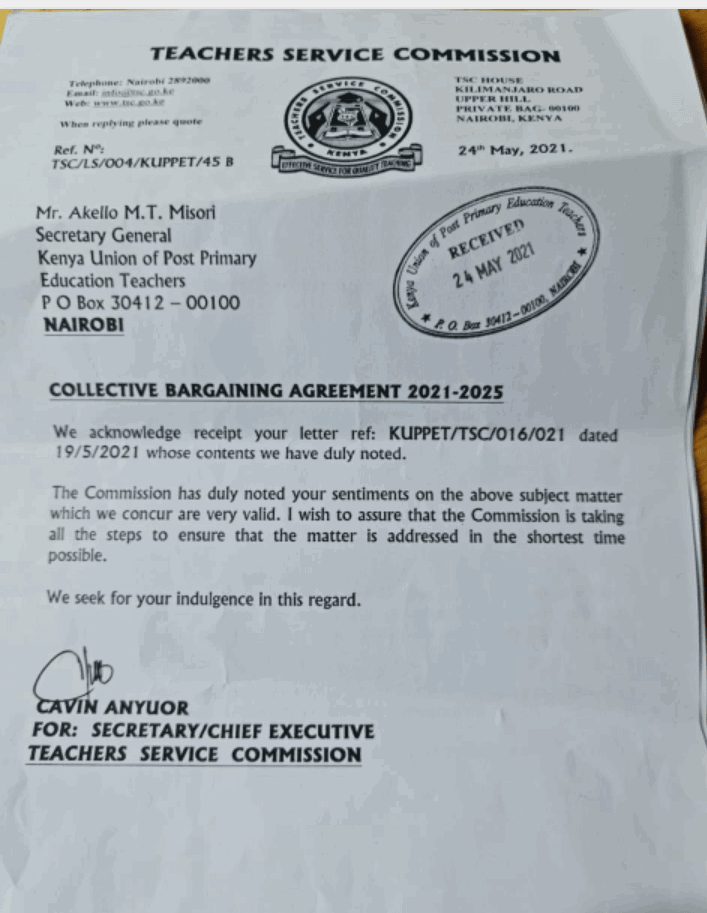
“The Commission has duly noted your sentiments on the above subject matter (CBA 2021 – 2025) with which we concur to be valid. I wish to assure that the Commission is taking all the steps to ensure that the matter is addressed in the shortest time possible,” said TSC CEO Dr. Nancy Macharia.
In April National Treasury Cabinet Secretary Ukur Yatani wrote to the Salaries and Remuneration Commission (SRC) that his ministry will not release close to Sh83 billion in salary increment that the State owes civil servants and teachers.
In a letter dated March 18 and addressed to Anne Gitau, the Commission Secretary at SRC, Yatani attributed this to budgetary constraints due to the upcoming General Election and the adverse effects of the Covid-19 pandemic.
We will address CBA 2021 – 2025 matter in shortest time, says TSC
TSC reply to Kuppet on CBA 2021 – 2025
Teachers unions protested the decision. Through their labour unions, teachers and civil servants threatened to down their tools should the government not honour the various collective bargaining agreements (CBAs) it struck with them.
The implementation of the new CBA is supposed to begin on July 1, 2021
At least 320,000 teachers across the country are anxious as their Collective Bargaining Agreement nears its expiry date.
The current CBA will expire at the end of the month but TSC has failed to make a counter offer to the one made by teachers’ unions in the 2021-2025 CBA.
The current CBA, signed in 2017 was implemented in phases for the last four years at a cost of Sh54 billion and will expire on June 30, 2021.
CBAs are usually discussed and implemented across four years.
Ordinarily, talks for a new cycle between the teachers’ unions and TSC are done at least a year before the expiry of the existing one.
The next elections, Yatani said, will cost taxpayers a total of Sh42 billion.
“We have already factored Sh10 billion in the Financial Year 2021-22 ceilings for the preparatory activities,” said Yatani, adding that the remaining balance will be factored in the next financial year.
This combined with a drop in taxes collected, Yatani said, forced the Exchequer to set aside only Sh6.8 billion, or 10 per cent of the Sh68 billion meant for the four-year salary reviews for national government workers in the upcoming budget. This excludes county workers.
The remaining cash would be released in phases in the financial years 2022to 2023-2024 to 2025.
However, labour union leaders castigated Yatani for using elections and Covid-19 as a reason to withhold their dues.
“The Government and employers should prepare for stiff resistance from unions,” said Wilson Sossion, Kenya National Union of Teachers (Knut) Secretary General, adding that the economy was more than capable of accommodating Sh83 billion, with close to two-fifths of this earmarked for teachers.
The National Treasury has projected that it will collect Sh1.76 trillion in taxes in the financial year beginning July even as it seeks to turbo-charge an economy that has been devastated by the pandemic.
“Further, due to the negative effects of Covid-19 on the economy we expect the economy and the projected slow recovery, revenue performance over the next two years,” said Yatani.
The National Treasury had earlier stated that it expected the economy to recover this year, growing at around seven per cent compared to slower estimated growth of 0.6 per cent in 2020.
A rebound in growth will largely depend on a return in investor confidence as infection rates go down. A faster rollout of the vaccine programme is also expected to help sectors such as aviation and hotel to return to normal.
After two successive quarters in which the economy contracted, the business climate seems to have recovered in the fourth quarter of last year after President Uhuru Kenyatta eased most of the containment measures.
But the optimism that was beginning to show bloom seems to have been blunted by a third wave of infections that saw the president introduce enhanced containment measures, including putting five counties on lockdown.
Cotu Secretary General Francis Atwoli said globally economies have been devastated by the pandemic.
“But counties make annual budgets. We do not have to wait for four years to think of workers’ plight,” said Atwoli.
He said the money being borrowed should be used to support Kenyans.
“I said it that the billions we are borrowing should supplement our budgetary allocations and also fight of Covid-19. But not to be pocketed by a few individuals,” said Atwoli.
The Public Finance Management Act 2012, however, does not allow the Government to use borrowed money to pay salaries.
Sossion said excessive borrowing in the economy cannot be used to punish workers.
“The CBAs must be funded as recommended by SRC. The Treasury and government cannot undermine what has been recommended by SRC,” said the nominated MP.
Kenya Universities Staff Union (KUSU) said the Government must look for money for the workers’ CBAs or risk an industrial action.
“Kenyans pay taxes and workers are the Kenyans. So they will have to get what is due to them. The Government must look for money to implement CBAs,” said Charles Mukhwaya, KUSU Secretary General.
“Sh6 billion is a drop in the ocean and a big joke.”
Kenya Union of Post Primary Education Teachers (Kuppet) Secretary General Akelo Misori declined to comment on the matter. “No comment at the moment,” said Misori.
This comes after Kuppet held a three-day retreat in Naivasha to iron out pending issues under the present CBA and to lay ground for the next phase of the agreement.
Insiders in the union however said the move would be a major setback for classroom teachers, who were expected to largely benefit from the next CBA.
Classroom teachers were given a raw deal under the present Sh53 billion CBA as it awarded staff with supervisory roles such as head teachers and their deputies.
Union of Kenya Civil Servants Deputy Secretary General Jerry ole Kina said they are in the last phase of their CBA and noted that they have been in talks with the Government.
“We have been trying to monitor the development. We are expecting the Ministry of Public Service tomorrow (Monday). We have been in discussion. Before we can comment, let’s hear them first,” said Kina.
“If it’s a positive answer we shall welcome. If this is for entire public service then we need to know the fine details of what they are talking about.”
Atwoli took issue with the manner in which public servants’ CBAs have been structured.
CBAs, he said, should be of two-year cycles and not four years as is the present practice.
“And they have arm-twisted the unions to accept the four-year cycle, which is illegal, unconstitutionality against the ILO (International Labour Organisation) conventions,” said Atwoli.
The Cotu boss said with two years cycle the issue of general elections would not arise.
He however said for good industrial relations, the Government must call unions and employers such as the Teachers Service Commission (TSC) to a meeting for presentations and justifications for their planned actions.
“Meet all the union leaders and explain to them why they want to pay less and also allow unions to ask questions like why pay less and Kenyans are paying taxes,” said Atwoli.

